The First World War, with its horrifying images of a massive human tragedy in a senseless turmoil, while the consequences followed in the Second World War, was becoming a safe platform for nationalist propaganda since the beginning of the seventees, fueling the dissatisfaction with the status of Serbs and Serbia in the Yugoslav federation. The common Yugoslav state was the most important achievement of the war goals set by the Kingdom of Serbia in 1915. Two key literary concieved political pamphleths were presented in the novels of Dobrica Ćosić The Time of Death (Vreme smrti, I-III, 1972-1979) and Danko Popović The Book About Milutin (Knjiga o Milutinu, 1985). Since 1968, Ćosić was the informal leader of the nationalist Serbian anti-Titoist opposition, whose goals were defined in the 1986 Memorandum of the Serbian Academy of Sciences and Arts, calling for a national gathering and a return to the command economy. In a long term, policy defined in The Memorandum exempted Serbia from the liberal-democratic consensus of the Eastern Europan states that abandoned the Soviet block and integrated into Western institutions. The Time of Death is a vague and pathetic epic that diverted the Serbian public’s attention from the essential problems in the politics and economy, as the collapse of market reforms, the strengthening of the Yugoslav People’s Army (YPA), becoming an active agent in federal and national relations, and the new rapprochement with the Soviet Union. Especially great excitement was created by the dramatization of the novel in the play The Battle of Kolubara (Kolubarska Bitka, 1983). The two hundred and fiftieth performance of the play, on November 28, 1990, was recorded by Belgrade TV broadcast. The Book About Milutin fueled national sentiments with a down-to-earth glorification of the idyllic village society and its fatal inadequacies. The main character Milutin narrates from the perspective of a political prisoner, a kulak, in Sovietized Yugoslavia after the Second World War, describing the history of the Serbian people and Šumadija region from the perspective of the tragic fate of his family, since the Sarajevo assassination in 1914.
The day-to-day political abuses of the memory of the First World War faltered in the shadow of the Yugoslav crisis and the aggression of the YPA against the secessionist republics, since 1991. The beginning of democratization and opening, following the regime change in 2000, exposed Serbia to challenges that the traditional communist-nationalist establishment, temporarily defeated, did not intend to accept, as integration into EU and NATO institutions. That is why The Memorandum propaganda, over time the state policy in depth as well, was concentrated on approaching the Putin’s Russia. The commemoration of the centenary of the outbreak of the First World War in 2014 was placed in the same and precise context.
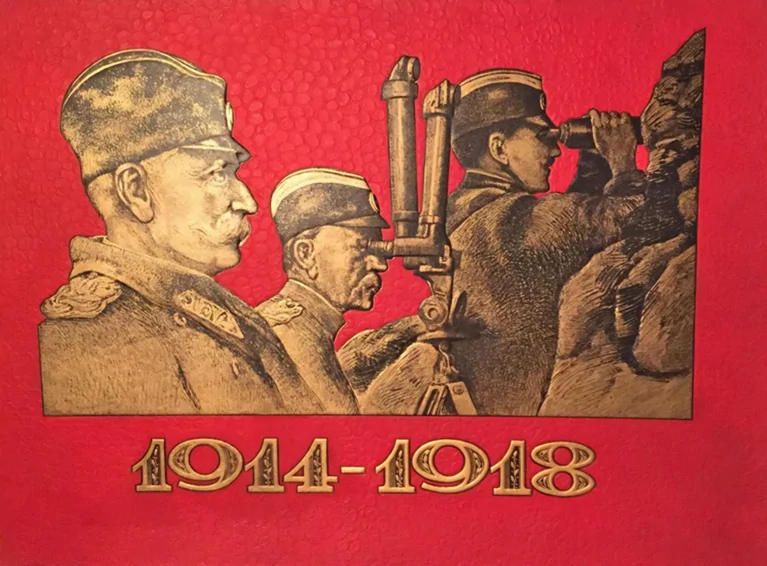
The remembrance of the mass suffering of Serbian soldiers and civilians generally emphasized that the other Yugoslav peoples allegedly did not appreciate enough Serbian sacrifices invested in the establishment of a common Yugoslav state. Official propaganda, during last 25 years, also used a promotion of The War Album 1914-1918, collected by lieutenant colonel Andro Popović and published in 1926. The course of the war is illustrated with photographs, pictures, sketches, maps and a historical overview of all important events. The text, with French and English translations, historical maps and about 3,000 photographs are arranged chronologically and by warfare fronts. The author pointed out that the War Album is „a candle that will burn forever“.
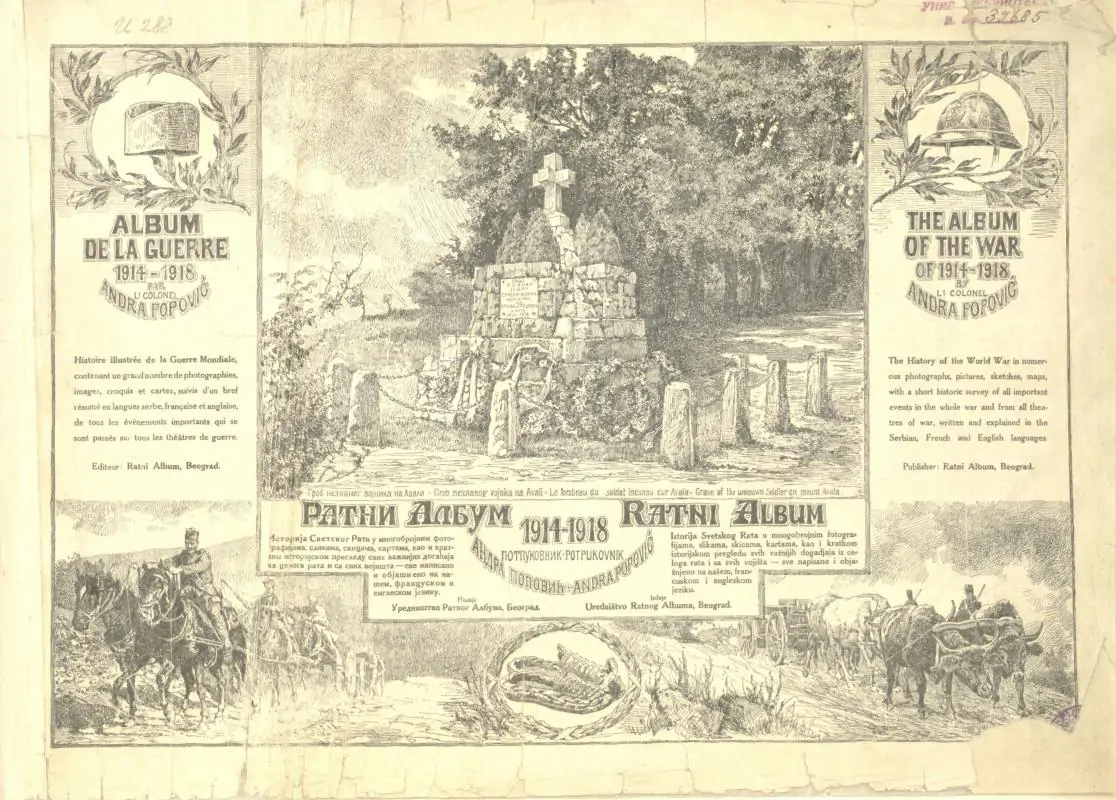
The War Album first edition from 1926 digitized and in open-access through University Library of Serbia „Svetozar Marković“
http://ubsm.bg.ac.rs/cirilica/dokument/103/ratni-album-1914-1918
In 2014, the promotion of the new edition of the album issued by „Pravoslavna reč“ with the forewords by the historian Milorad Ekmečić and the President of the Republic of Serbia Tomislav Nikolić, held in the House of the Army (the former YFA propaganda stronghold), was a manifestation of the synergy of the army and the church in the new regrouping and positioning in the EU neighborhood initiated by Russia’s first aggression against Ukraine. The former president concluded that photography is both a witness and an emotional experience, „It preserves our specific memory and preciously defends it so that some stray, late bullet of today’s conscience-washers does not kill our honorable history“.
Promotion of the new edition of war Album in 2014:
Serbian Patriarch Irinej pointed out that the only suffering of the Jewish people can be compared to the Serbian sacrifices in the 19th and 20th centuries, as the Christian, fraternal peoples committed unimaginable atrocities with the intention of exterminating the Serbs. „It is good that this book reminds us of this, because we are among the peoples who very quickly forget what must not be forgotten and remember poorly what must never be lost sight of. It is good that this book reminded us of the past in which the Serbian people showed great heroism, great perseverance, but also great suffering“.
Promotion in Banja Luka
Nikola Samardžić