
In memory of the Serbian and French army cadets who lost their lives in the sinking of the ship SS Polynesien on August 10 th, 1918
A tribute those who perished in World War I and the common history of Serbia and Malta
One of the lesser-known episodes from the history of the Serbian Royal Army during World War I took place on August 10th, 1918, off the coast of Malta. The French ship Le Polynesien was transporting around 500 Serbian soldiers — cadets of the Reserve Officers’ School from Bizerte — to the Thessaloniki Front. Among the young Serbian officers and soldiers was the famous heroine Milunka Savić. At around 11 a.m., the ship was struck by a torpedo fired from the German submarine UC-22, about three kilometers off the coast of the small fishing village of Marsaskala, in southern Malta. Within 45 minutes, the vessel sank, taking with it 11 crew members and 6 Serbian soldiers (the exact number of casualties remains uncertain). The survivors were rescued and treated in a Maltese hospital before being transferred to the Thessaloniki Front, where they later joined the final battles for the liberation of Serbia.
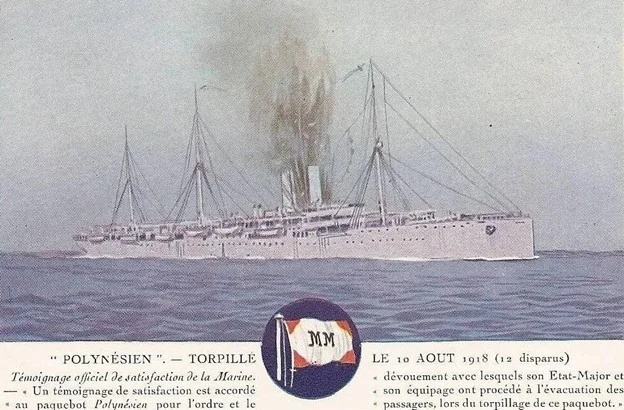
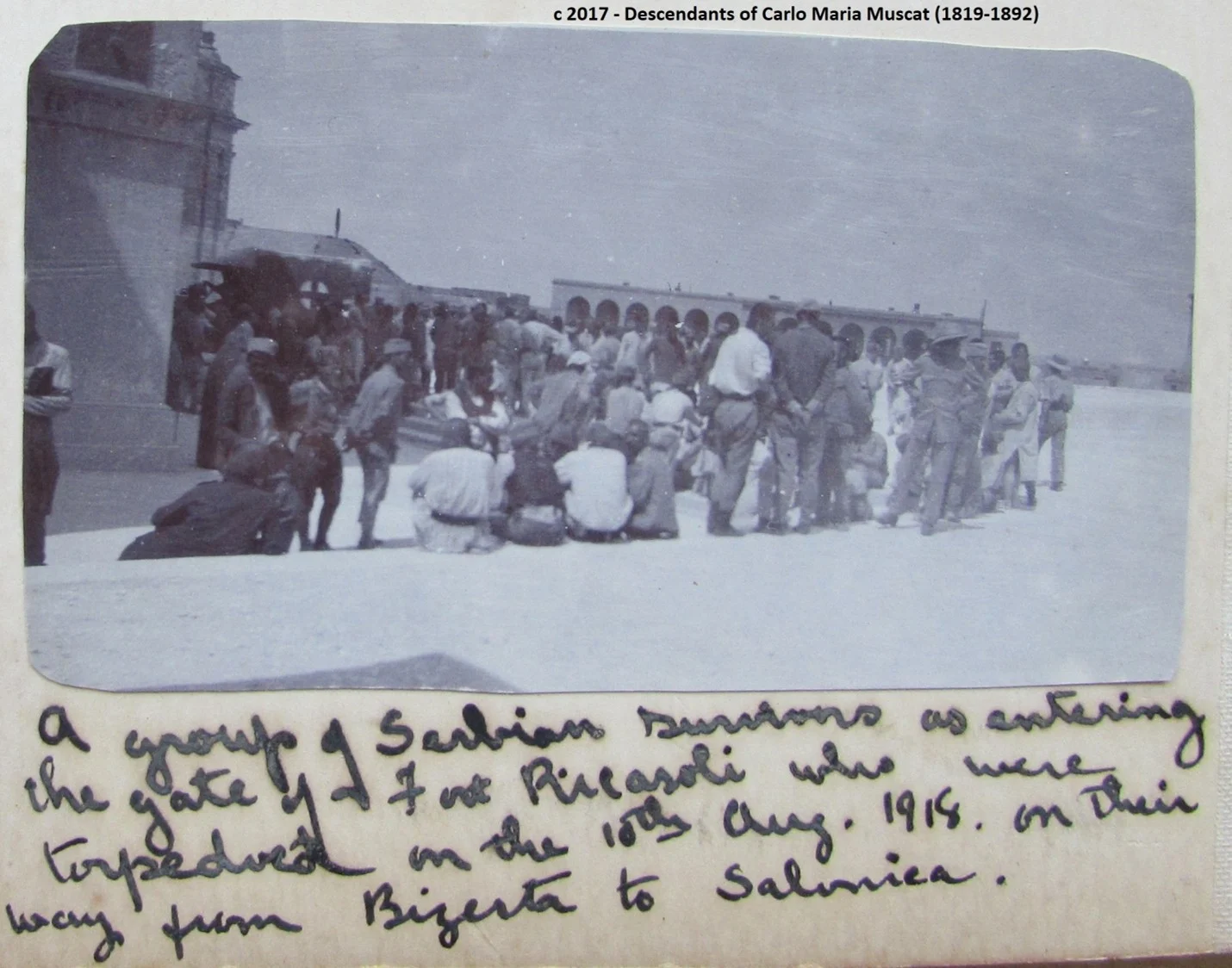
Mary Anne Muscat was born in Mdina, Malta, in 1887. Mary made a major photo album of her time as a nurse in Malta in WW1 http://agiusww1.com/mary-muscat-2/ . The photos include many unique views around Malta and names of a number of soldiers that Mary nursed and worked with. Among her photographs are those featuring the Serbian soldiers who were treated in Malta following the sinking of the Polynesien in August 1918, as attested by the note in her own handwriting on the photograph above.
On July 28th, 1918, the French ship Le Polynesien departed from the port of Bizerte, carrying cadets of the Serbian Non-Commissioned Officers’ School to the Thessaloniki front. Among the young cadets on board was the Serbian heroine and most highly decorated woman of World War I — Milunka Savić. The Polynesien was under the command of Second Lieutenant Siniša R. Tajišić, an active infantry officer from Kragujevac. The convoy leaving Bizerte consisted of around ten transport ships carrying military supplies to Thessaloniki, escorted by several destroyers for protection against enemy submarines.
The voyage began calmly, with all precautionary measures in place. According to survivors’ testimonies, the first morning passed uneventfully until around 11:00 a.m., when a sudden, powerful explosion shook the ship. Milunka Savić later recalled fearing that her life would end in the depths of the Mediterranean, saying that “death did not want her,” as she miraculously survived — never knowing how many cadets had perished. One of her fellow passengers, Dušan Stanković, left a vivid testimony describing the final moments aboard the Polynesien:
“Suddenly, the ship trembled with a deafening explosion, and we fell to the deck… The siren wailed ominously, the ship tilted, panic broke out… We ran from bow to stern, tripping over one another… There was a struggle for life belts, as some hadn’t fastened theirs properly… The ship leaned further to the left… We ran toward the part that was still above water, lowering lifeboats and rafts. Second Lieutenant Tajišić was calm and composed, giving orders and trying to stop the panic… Boats filled quickly and moved away… Tajišić was the last to stay aboard, ensuring every soldier was rescued. He tried to lower a small boat, but one end broke free and he fell into the sea… The water pulled him down — he never resurfaced. Thus, without a word, saving his cadets and waiting until the last man boarded, the brave and noble Lieutenant Tajišić said his final farewell…”
“Soon, small British rescue ships arrived from Malta and pulled us from the sea. The ordeal lasted 45 minutes. When the masts of the Polynesien disappeared beneath the waves, we, the surviving cadets and French sailors, stood at attention and paid our final respects to the ship and our fallen comrades. In the depths of the Mediterranean, some of our brothers remained forever.”
Alongside Lieutenant Tajišić, two cadets lost their lives. The survivors were rescued by Allied vessels near Malta and later continued their journey to the front. By September 1918, they rejoined their units and took part in the final battles for the liberation of Serbia.
The shipwreck remains well preserved to this day, lying at a depth of 68 meters, and is now considered one of Malta’s most remarkable and technically demanding diving sites. Serbian Educational and Cultural Centre St. Helen of Anjou, established in 2021 in Malta, launched an initiative to install a memorial monument in Marsaskala, on the very shore overlooking the site of the sinking. The monument features a sculptural representation of the sunken vessel in a 1:100 ratio (length of represented ship 1.52m, original length of ship 152m) — the upper part representing the ship in motion and the lower part depicting the wreck of the Polynesien — accompanied by an informative plaque in Maltese, Serbian, and English. The raising of the monument was supported by the Serbian company Argo Navis, contributing to the technical production of the 3D ship and wreck models for casting, the British company 3DMB, which provided the digital model of the wreck of the Polynesien, the Marsaskala Local Council and its Mayor Mario Calleja, and Professor Timmy Gambin from the University of Malta, responsible for the preservation of Malta’s underwater cultural heritage. The monument is located on the shore of Saint Thomas Bay in Marsaskala in Malta, facing the open sea and the spot where the Polynesien was sunk.
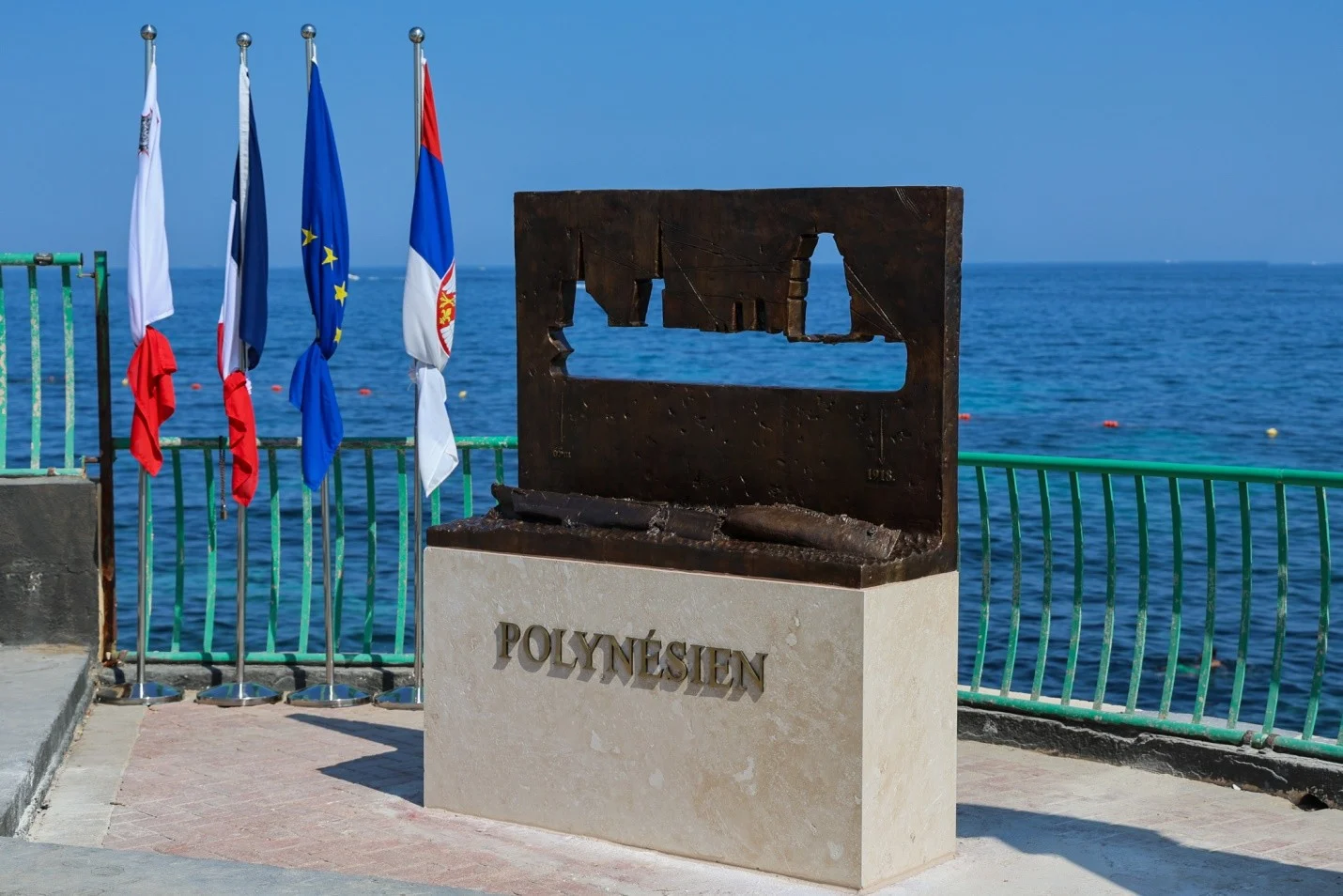
The entire process and memorialization of the monument was initiated and seen to its successful completion by Mr. Petar Maksimović, a Serbian residing in Malta, and one of the founders of the Serbian Educational and Cultural Centre St. Helene of Anjou. Mr. Maksimović is also the ideator and technical designer of the monument itself which was subsequently produced by two Serbian sculptors, Jelena Božović Đorđević and Igor Đorđević. The official unveiling ceremony, in the presence of Maltese and Serbian authorities, as well as representatives of the French embassy in Malta, took place on August 10th, 2025 – on the 107th anniversary of the sinking of the Polynesien.
Jelena Erdeljan
Sources: