Discovering WWI Stories in Serbia
by historian Vladimir Abramović
Faculty of Philosohy in Belgrade
Communicating with local museums in Serbia could be a mixed experience. Depending on the topic and on the museum in question, the experience could range from an enthusiastic reception of a request, a swift reply and delivery, to a palpable exasperation of museum staff with “another pesky researcher”. And some of these experiences are special indeed.
On a cold winter’s evening, while I was out and about, I received a call from an unknown number. The voice on the other side presented himself as a fellow historian Aleksandar Marušić from the Museum of Rudnik and Takovo area in Gornji Milanovac. He explained that he received my email about the objects and artefacts from WW1 relevant for our project, and that he felt more comfortable talking with me about the topic rather than just replying to a message.
After a brief discussion, he invited me to visit the museum and personally see the artefacts in their possession. Naturally, I accepted the invitation, somehow anticipating that it would be an interesting experience. We agreed that the day of my visit should be on January 5th, a rare working day between New Year’s Eve and Orthodox Christmas (January 7th).
And on January 5th dawned a special day indeed. After two days of heavy snowfall, the streets of Belgrade resembled a place from fairy tales set in the frozen north – idyllic if observed through a warm room’s window with a mug of hot cocoa in hand, but not-so-charming for one trying to dig his car from under the snow and dealing with inevitable slush. However, the agreement has been made, and there was no turning back. I was quite amused to note that I needed almost the same amount of time to get from my house to the highway, then from that point to Gornji Milanovac. After an uneventful drive on a remarkably clear road, I have reached my destination.
The administrative department of the museum is located on the last floor of the “Dečje novine” building – once the largest publisher of comic books in Yugoslavia, now sadly defunct. To my surprise, I found out that the offices were full of stacks of books, almost to the point of obscuring the view. To my query, my colleague explained that all of those are Museum’s publications. I was really impressed by the volume and the quality of books, catalogues and brochures. My surprise got even greater, when he clarified that the whole staff numbers just 18 employees. However, its production and number of exhibitions, panels and lectures could easily rival those of much larger museums and cultural institutions.
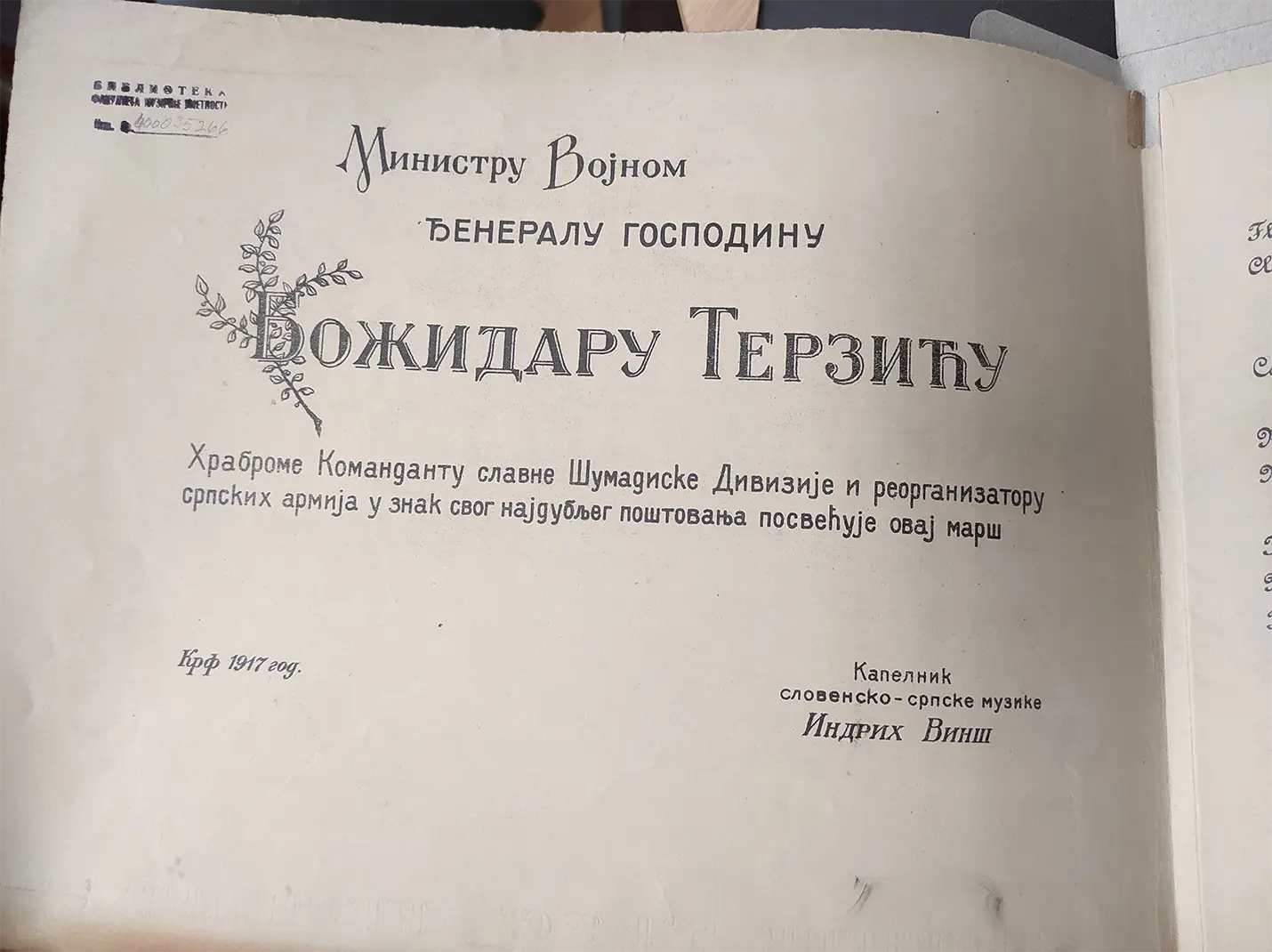
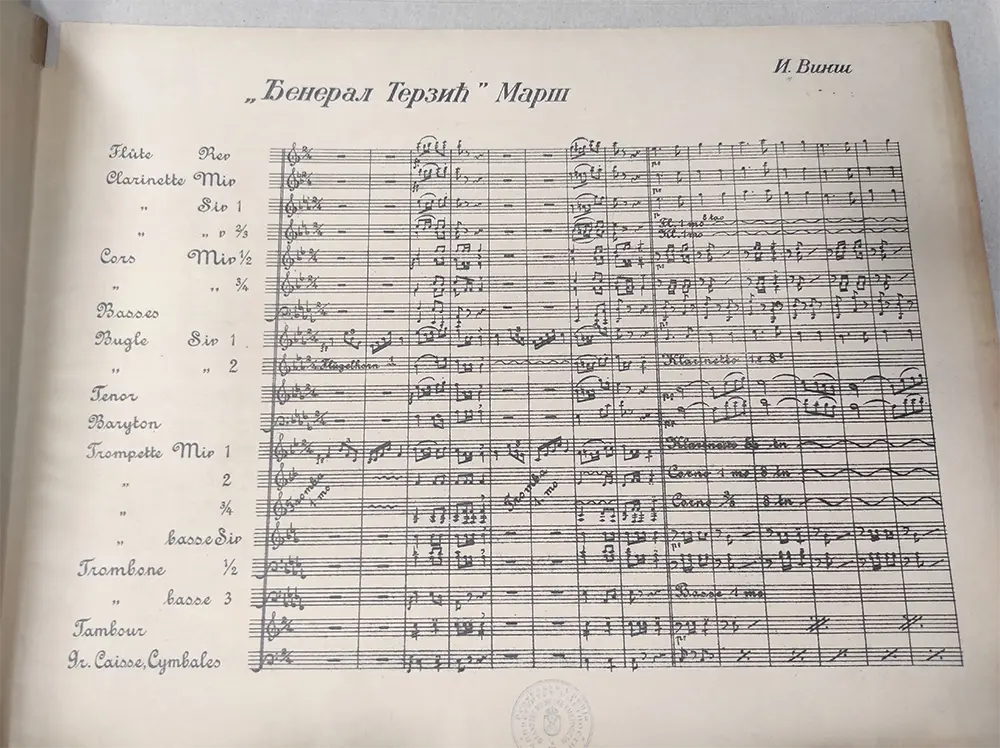
Moving on to the Museum’s proper building, I was introduced to various collections ranging from prehistory and antiquity to the modern era. A corner of the Museum is dedicated to WW1, holding various interesting artifacts, mostly containing photographs, medals, documents and various examples of trench art. A significant part of the permanent exhibition is devoted to general Božidar Terzić, a native of Gornji Milanovac and an extinguished commander and Minister of the Army. An exceptionally rare artifact in Museum’s possession is a record containing “General Terzić March,” made during the war’s closing years, or immediately after. It’s 16 RPM, but unfortunately the record is damaged, and it couldn’t be played. Curiously, I have previously found in Belgrade a neglected sheet music of the March, authored by Indrih Vinš (Jindřich Winš) in 1917.
Aleksandar mentioned a certain curiosity that really piqued my interest – at the Gornji Milanovac City cemetery there is a monument and ossuary dedicated to both Austro-Hungarian and Serbian soldiers. I replied that it is indeed curious, because it is not a widely known fact; furthermore, it was unusual to erect such monuments during the war. The inscription on the monument reads:
Hier ruhen
Oestereich-
Ungarische
und Serbische
Helden
Here rest
Austro-
Hungarian
and Serbian
heroes
Our conversation took us to another interesting story – in the village of Ljutovnica, about 7 km from Gornji Milanovac, at Rade Jeremić’s estate, there is a grave of two unknown Austro-Hungarian soldiers, who were buried there in the autumn of 1915. The inscription is simple and reads:
1915
+
Hier
ruhen
Namenlosen
Helden
1915
+
Here
rest
unknown
heroes
The most interesting story about this monument is that the members of the Jeremić family light candles every year on the Saturday of Souls. Furthermore, during village lityas, a priest censes the grave. We discussed how this was probably a remnant of a custom established during the war or immediately after. It is surprising that it came into being in the first place, bearing in mind the ferocity of Austro-Hungarian invasion and brutal reprisals against the civilians of this area during the war’s opening years. There was, of course, the practice of erection of joint memorials, graveyards and ossuaries during the war, as mentioned before, but it was comparatively rare.
We speculated that it might be the last glimmer of a distant chivalric age, a thought that is at the same time sombering and somehow heartwarming. With that we said our goodbyes and I returned to Belgrade full of impressions and laden with books, gifted by the Museum.